Thursday, June 16, 2011

Convergent Skulls: Walrus and Elephant

I was watching on episode of Oddities a while ago (a great tv series for skelephiles and other fans of odd stuff), and someone brought in a walrus mandible (actually both mandibles fused). The expert they had look at the bone commented on how similar it was to an elephant mandible, despite the very different diets of the two animals.

That got me thinking about walrus and elephant skulls and the similarities they have evolved, largely due to the fact that both animals need skulls that can support a massive pair of tusks. Of course, there are also a lot of differences, but have a look at these simplified illustrations.


Obviously, these are not to scale. I don't have anything profound to say here, just that it's cool to think about how the bones of animals can be so similar or so different, depending on how they developed.

Wednesday, June 15, 2011

Bone Art: Takayuki Hori

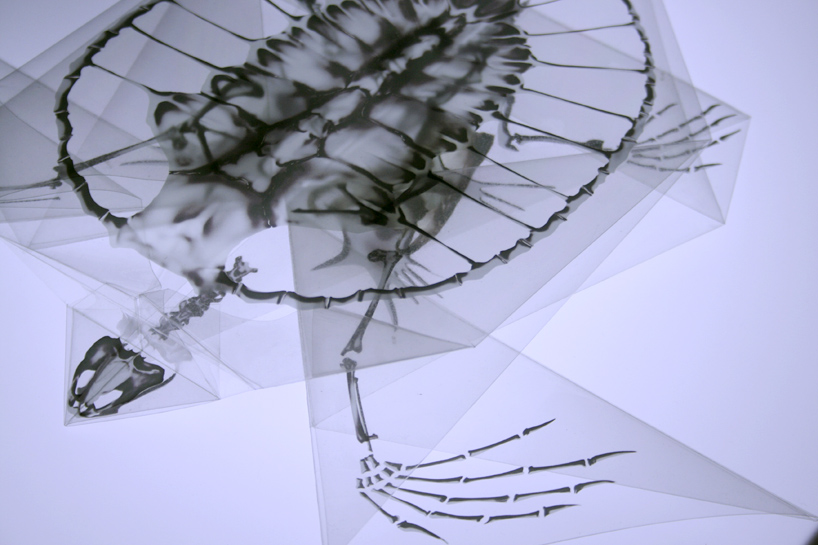
Here's something absolutely breathtaking: "Oritsunagumono" by artist Takayuki Hori.


Each piece was printed on translucent paper and then folded using traditional origami patterns. Some of them have coloured images of trash superimposed on them, as a comment on "the animal's plight to survive in an increasingly polluted and hazardous ecosystem."

The pieces are displayed on a lightbox, with an unfolded version of the image in a frame on the wall behind. See more photographs on designboom. Really, go and look, this work is just amazing.

Some of you may know that I'm also a letterpress printer, and I'm just dying to borrow this idea and letterpress print skeletons on origami paper. I don't know if I will, though, except maybe to make a few for myself.

Monday, May 9, 2011

Book Review: How to Build a Dinosaur

How to Build a Dinosaur: The New Science of Reverse Evolution
How to Build a Dinousaur: Extinction Doesn't Have to Be Forever by Jack Horner and James Gorman. London and New York: Dutton, 2009.

There are a couple of things misleading about the title of this book. First, it's not really about how to build a dinosaur, it's about the science that has lead up to the possibility that we might someday be able to create a living dinosaur out of a bird embryo. And second, it's not really about bringing anything back from extinction, it's about using the way a growing creature's genetic code sends instructions to its cells to learn about how evolution has progressed and in the process change the development of a chicken so that it grows into something more commonly recognizable as a dinosaur (because, or course, birds are already dinosaurs). There's nothing about tinkering with the DNA itself.

That said, this is a great book, and though it's not entirely focused on bones there is more than enough cool bone science for the curious skelephile. If you're into dinosaurs (and if not, what's wrong with you?), or the evolution of birds, or if you're interested in how embryonic development makes a skeleton grow a pygostyle, say, instead of a tail, you should add this volume to your library. Jack Horner is an articulate and enthusiastic dinosaur guy, and with the help of co-author James Gorman he's written a very readable book that intelligent readers of just about any level of dinosaur knowledge can enjoy.

I would have liked to see a few more illustrations or photographs, but the lack of them isn't really a strike against the book. The most important things get visuals--I'd just have liked to have had a few more things to ponder visually.

Though this isn't a book aimed at a scholarly audience, I do think bone scholars would find a lot to like here. Plus, there are references in the back for each chapter, so the interested can pursue the scientific papers and books that inform the discussion.

I based this review on the 2009 hardcover version that I found remaindered at the local book store. I see, though, that a paperback with a different subtitle (The New Science of Reverse Evolution) came out in 2010. I've no idea if anything else changed besides the title, but if you're going to buy it full price, you might want to go for the more recent edition.
 

Monday, May 2, 2011

Bone Art: Jessica Joslin


There's a great interview with artist Jessica Joslin over at Hi Fructose magazine. Here's a little snippet that really struck me, though I encourage you to read the whole thing:
There is a strange intimacy in working with bones, and there are often tangible tales about the animal's life embedded within. I know whether it died young or old, if it had arthritis or parasites, if it had broken a bone and if so, how long ago and whether it would have limped. It might have bits of shrapnel embedded, with the bone grown up around it like a pearl--that tells me that it had a run-in with a hunter and survived. Fellini once said, “The pearl is the oyster's autobiography.” If you know how to read them, bones are an animal's autobiography.
On my list of artists whose work I would like to own if I became suddenly wealthy, Joslin is pretty close to the top. I could imagine a crazy Victorian house filed with her sculptures (though actually I want a Craftsman house some day).

She's also got a gorgeous new website with many, many pictures of her work. Looking through them all, I really wished for a nice, heavy art book that I could flip through on my couch. And look, there is a book! I'll have to save my pennies and buy a copy.

Wednesday, April 13, 2011

Natural History Museums

I was reminded by a post on James Gurney's art blog ("Museum of Comparative Zoology") that natural history museums are a great place to find bones to look at. In addition to the displays of mounted skeletons, many museums--especially the larger ones--have comparative collections that may be available for researchers. Even if they don't, it can be fun to spend an afternoon (or in the case of larger museums, several days) wandering the displays, snapping photos and making drawings.

Gurney wrote about the Museum of Comparative Zoology at Harvard University, and not only is it a great museum (and on my list of museums to someday visit), it also has a fantastic web site.

Last time I went to the museum closest to me--the Museum of Natural History in Halifax, Nova Scotia, I neglected to take my camera, but I did have my old iPhone 3G, and I snapped a few not-very-good photos for reference.


Sharks! And a horse:


A dolphin:


A small whale:


And a really big T. rex named Sue (on loan from the Field Museum in Chicago):

Tuesday, April 12, 2011

Bone Art: Kate MacDowell

Thanks to a friend's StumbleUpon bookmarks, I came across the incredible ceramic sculptures of Kate MacDowell a day or two ago.


Notice the human skeleton. She has several more along the same lines, as well as other beautiful, surreal pieces. Songbirds perching inside a pair of human lungs, literal clay pigeons, and other wonderful things. Go look at her portfolio, you will be amazed.

Sunday, April 3, 2011

Oddities

Last night I was finally able to catch a couple of episodes of the Discovery Channel show Oddities (I'm in Canada, and US shows, if we get them at all, usually get here much later). It's a lot like Pawn Stars or American Pickers--in fact, even the wording of some of the commentary is so similar it made me wonder if they're using the same writers--but set in an antique shop that caters to collectors of, well, oddities.

Aside from being a total blast for anyone interested in weird stuff, there was a lot for a bone collector (or other skelephile) to love. There are plenty of skulls and jarred specimens in the background, and one of the episodes I watched featured the skull collections (mostly human) of one of the employees and his rival, a chiropractor and regular customer. Said employee (my apologies--I haven't got their names stuck in my brain yet) also constructed a Beauchene (or "exploded") skull from a disarticulated skull that his rival/friend brought in.


Very cool. And both skull collectors had fantastic shelving, too! I want those glass-fronted cases for my collection. And for my books. So check it out, and have a look at the website, too, it'll give you a taste of the show, and there are some neat exclusives.

My only quibble is that the episodes are only a half hour each, so there's no real time to delve into the history and background of the objects, or the lives of the proprietors and their colourful cast of customers. Still, an excellent show, and one I might even pick up on DVD if it gets a release.

Skull image copyright Niko Silvester. Please don't use without permission, thanks.